
Learning
Login to enroll in courses and start learning
LoginAccounting Principles and Double Entry Bookkeeping
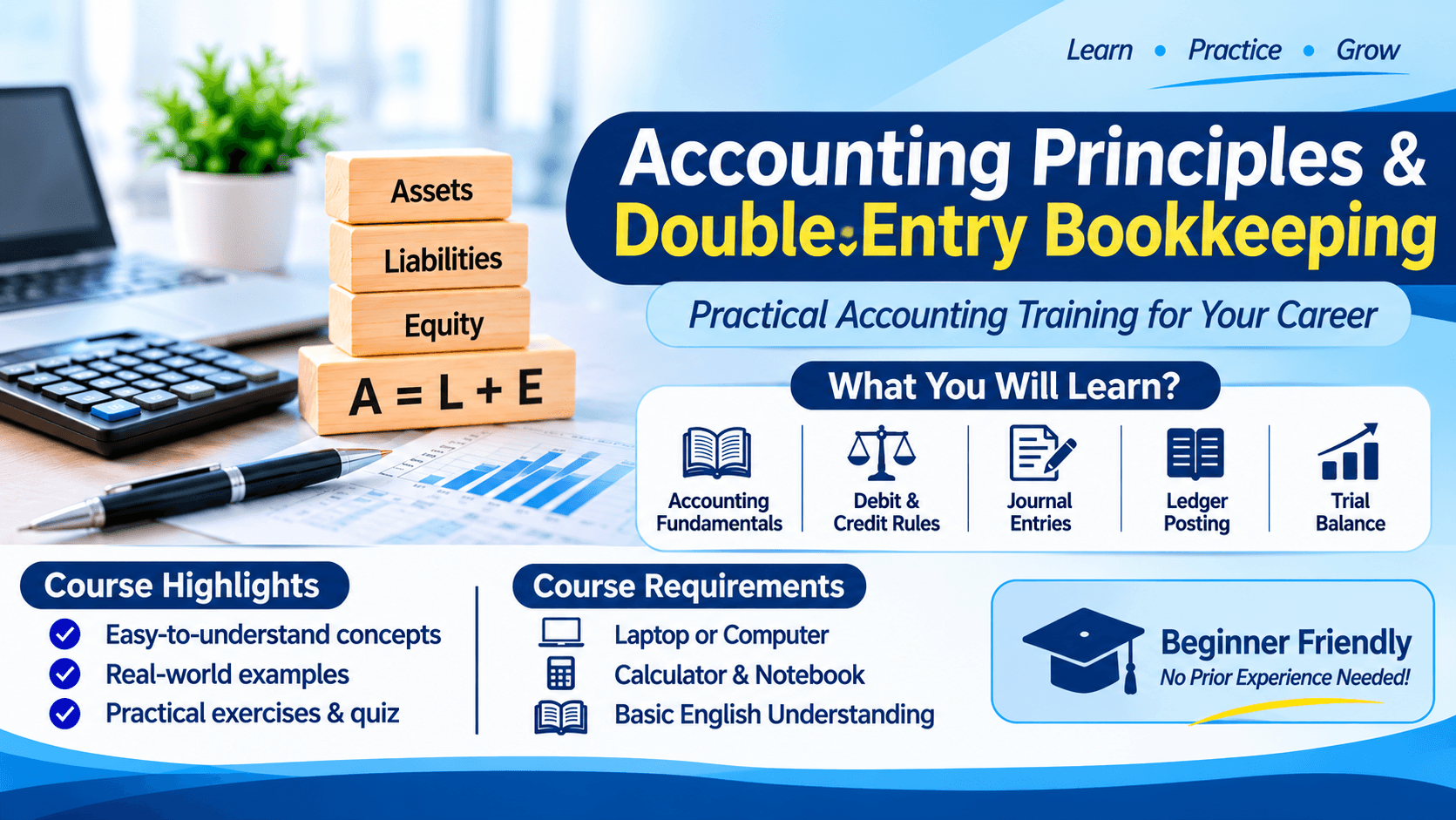
Learn accounting fundamentals, debit and credit rules, journal entries, ledger posting, and trial balance preparation through practical bookkeeping exercises.
What you'll learn
- 1. Accounting principles and the accounting equation
- 2. Chart of Accounts
- 3. Cash Basis and Accrual Accounting
- 4. Journal Entries and Double-Entry Bookkeeping
- 5. Ledger Accounts and T-Accounts
- 6. Trial Balance Preparation
- 7. Accounting Errors and Corrections
About this course
This course introduces students to the fundamental principles of accounting and double-entry bookkeeping through practical business examples. Students will learn the accounting equation, chart of accounts, debit and credit rules, cash and accrual accounting, journal entries, ledger posting, T-accounts, and trial balance preparation. The course also covers common accounting errors, correction methods, practical exercises, and knowledge assessments. By the end of the course, students will develop a strong foundation in bookkeeping and understand how financial transactions are recorded and maintained in a business.
Curriculum · 7 sections · 35 lessons
Section 1: Introduction to Accounting Principles
- Accounting Principles and Double Entry Bookkeeping—
- Lesson 1.1: Understanding Accounting Principles—
- Lesson 1.2: The Accounting Equation – Assets = Liabilities + Equity—
- Lesson 1.4: Types of Accounts – Assets, Liabilities, Equity, Income and Expenses—
- Lesson 1.3: Understanding Debit and Credit Rules—
Section 2: Chart of Accounts and Accounting Methods
- Lesson 2.1: Introduction to Chart of Accounts—
- Lesson 2.2: Account Codes and Account Classification—
- Lesson 2.3: Understanding Cash Basis Accounting—
- Lesson 2.4: Understanding Accrual Basis Accounting—
- Lesson 2.5: Deferred Revenue and Accrued Transactions—
Section 3: Journal Entries and Double-Entry Bookkeeping
- Lesson 3.1: Introduction to Double-Entry Bookkeeping—
- Lesson 3.2: Understanding Journal Entries—
- Lesson 3.3: Recording Business Transactions – Part 1—
- Lesson 3.4: Recording Business Transactions – Part 2—
- Lesson 3.5: Practical Debit and Credit Exercises—
Section 4: Ledger Accounts and Trial Balance
- Lesson 4.1: Introduction to Ledger Accounts—
- Lesson 4.2: Understanding T-Accounts—
- Lesson 4.3: Posting Journal Entries into Ledgers—
- Lesson 4.4: Calculating Ledger Balances—
- Lesson 4.5: Introduction to Trial Balance—
- Lesson 4.6: Preparing a Trial Balance—
Section 5: Accounting Errors and Corrections
- Lesson 5.1: Understanding Common Accounting Errors—
- Lesson 5.2: Identifying Missing and Incorrect Entries—
- Lesson 5.3: Understanding Transposition Errors—
- Lesson 5.4: Correcting Accounting Errors Through Journal Entries—
Section 6: Practical Accounting Workshop
- Lesson 6.1: Recording Business Expenses—
- Lesson 6.2: Recording Software Purchases and Credit Transactions—
- Lesson 6.3: Recording Owner's Drawings—
- Lesson 6.4: Recording Supplier Payments—
- Lesson 6.5: Recognising Deferred Revenue as Earned Income—
- Lesson 6.6: Practical Journal Entry Worksheet—
Section 7: Accounting Terminology and Assessment
- Lesson 7.1: Essential Accounting Glossary—
- Lesson 7.2: Understanding Important Accounting Terms—
- Lesson 7.3: Accounting Knowledge Assessment – 10 Questions—
- Lesson 7.4: Quiz Answers and Review—
Requirements
- B.Com, M.Com, BBA and other Commerce students.
- Fresh graduates interested in accounting and finance.
- Beginners who want to develop bookkeeping skills.
- Working professionals who want to strengthen their accounting fundamentals.
Ratings & reviews
Discussion
Login to join the discussion