
Learning
Login to enroll in courses and start learning
LoginFinancial Statements and Month - End concepts
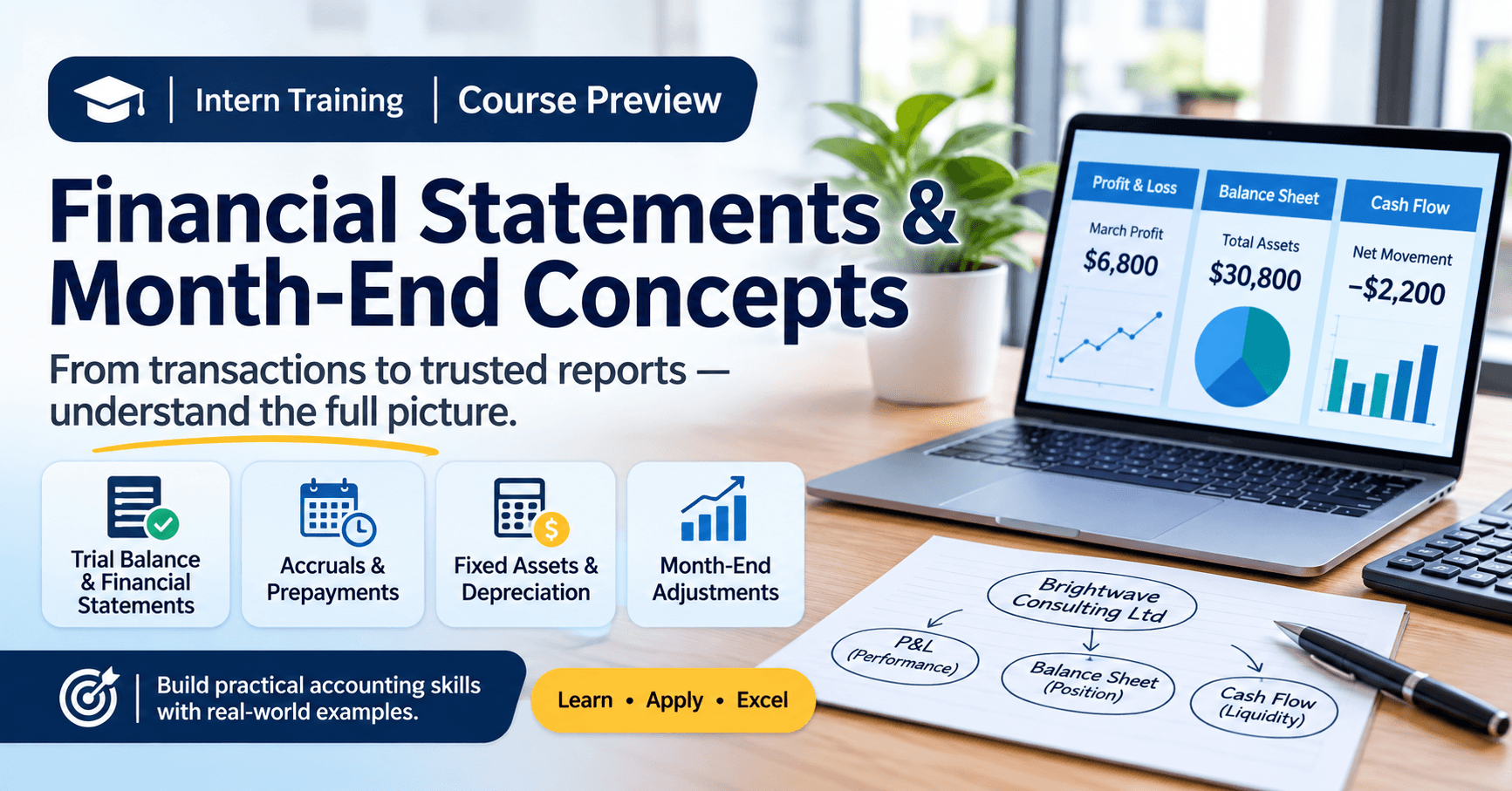
Understand how financial transactions flow into financial statements and how month-end adjustments ensure accurate reporting of profit, assets, liabilities, and cash.
What you'll learn
- Explain the purpose of a trial balance and why total debits must equal total credits.
- Differentiate between the Profit & Loss statement, Balance Sheet and Cash Flow statement.
- Explain how transactions affect financial statements.
- Understand the difference between accounting profit and cash flow.
- Apply the accrual and matching concepts.
- Identify and account for prepaid expenses and accrued expenses.
- Distinguish between an expense and a capitalized fixed asset.
- Calculate straight-line depreciation and net book value.
- Understand why month-end adjustments are necessary.
- Reconcile profit to operating cash flow using relevant adjustments.
- Identify the impact of unpaid receivables and liabilities on cash.
- Interpret basic financial information for business decision-making.
About this course
This course introduces learners to the fundamentals of financial statements and month-end accounting concepts using practical business scenarios. Learners will explore trial balances, Profit & Loss statements, balance sheets, and cash flow statements, and understand how transactions affect each statement.
Through examples and case studies, participants will learn the importance of accruals, prepayments, fixed assets, depreciation, and month-end adjustments. The course also demonstrates why profit does not always equal cash and how accurate accounting records support reliable financial reporting and business decision-making.
Curriculum · 9 sections · 53 lessons
Financial Statements and Month - End Concepts.
- Lesson1h
Section 1: Trial Balance Fundamentals
- Introduction to the Trial Balance—
- Understanding Ledger Balances—
- Debit and Credit Totals—
- Trial Balance Example—
- Balancing vs. Accuracy—
Section 2: Understanding the Three Financial Statements
- Introduction to Financial Statements—
- Profit & Loss Statement—
- Balance Sheet—
- Cash Flow Statement—
- How Financial Statements Connect—
Section 3: Business Transactions & Their Financial Impact
- Meet Brightwave Consulting Ltd.—
- Recording Consulting Revenue—
- Client Cash Collections—
- Rent Paid in Advance—
- Purchasing a Laptop—
- Unpaid Salaries—
- Transaction Impact Summary—
Section 4: Accruals & Prepayments
- Introduction to Accrual Accounting—
- Accrued Expenses—
- Prepaid Expenses—
- Rent Prepayment Example—
- The Matching Principle—
- Practical Application—
Section 5: Fixed Assets & Depreciation
- Introduction to Fixed Assets—
- Capitalization—
- Depreciation—
- Straight-Line Depreciation—
- Accumulated Depreciation—
- Net Book Value—
Section 6: Month-End Adjustments
- Why Month-End Adjustments Are Needed—
- Matching Expenses to the Period—
- Completeness of Financial Records—
- Adjusting Accruals—
- Adjusting Prepayments—
- Recording Depreciation—
- Adjusted vs. Unadjusted Profit—
Section 7: Practical Case Studies
- Case Study 1 – Profitable March, Shrinking Cash—
- Cash Position vs. Profit—
- Case Study 2 – The Invoice That Arrived in April—
- Accrual Adjustment Exercise—
- Case Study 3 – Expense or Fixed Asset?—
- Asset Capitalization Exercise—
Section 8: Profit-to-Cash Reconciliation & Assessment
- Introduction to Profit-to-Cash Reconciliation—
- Depreciation Adjustment—
- Changes in Receivables—
- Changes in Prepaid Expenses—
- Changes in Accrued Liabilities—
- Operating Cash Flow Calculation—
- Investing Cash Flow—
- Net Cash Movement—
- Knowledge Quiz—
- Quiz Review & Answer Key—
Requirements
- Basic understanding of business transactions.
- Basic familiarity with income, expenses, assets and liabilities
- No advanced accounting knowledge required.
- Basic numerical and calculation skills.
- Notebook or workbook for calculations.
Ratings & reviews
Discussion
Login to join the discussion