
Learning
Login to enroll in courses and start learning
LoginQuickBooks Online
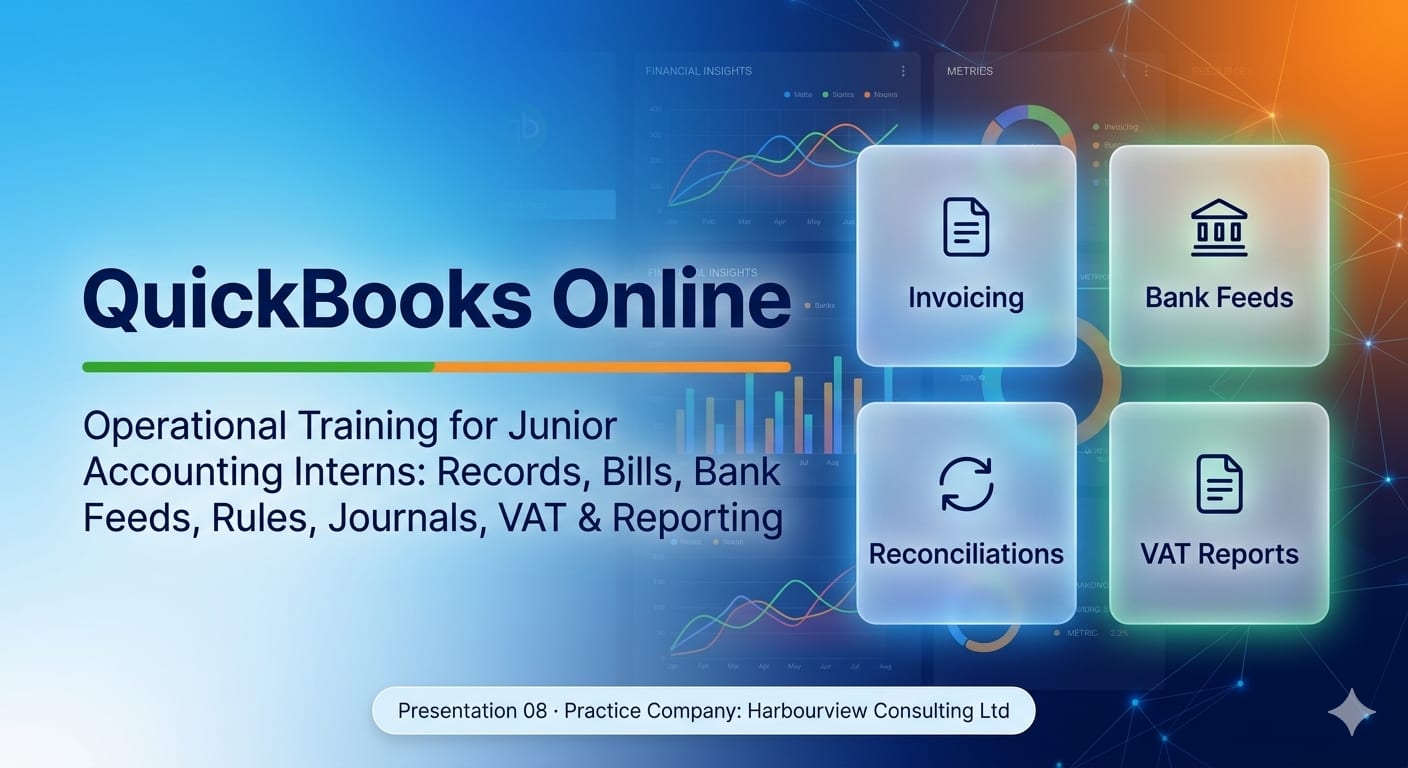
Learn to manage daily accounting operations, record transactions, reconcile bank accounts, handle VAT/tax, and generate financial reports using QuickBooks Online.
What you'll learn
- Navigate QuickBooks Online
- Manage Chart of Accounts
- Manage Customers and Invoices
- Manage Supplier Bills and Expenses
- Handle Bank Feeds and Rules
- Perform Bank Reconciliation
- Understand VAT and Tax Setup
- Record Journal Entries
- Generate Financial Reports
- Generate Financial Reports
- Perform Daily and Month-End Tasks
About this course
This course provides practical, hands-on training in QuickBooks Online, designed for junior accounting interns and beginners who want to develop essential cloud-based accounting skills. Students will learn how to navigate QuickBooks Online, manage the Chart of Accounts, create customer and supplier records, prepare sales invoices, record bills and expenses, and manage daily accounting transactions.
The course also covers bank feeds, bank rules, bank reconciliation, VAT and tax codes, journal entries, and financial reporting. Through practical transaction exercises, students will gain experience in preparing Profit and Loss Statements, Balance Sheets, Trial Balances, and Accounts Receivable and Payable Aging Reports.
Additionally, students will understand audit history, accounting security, daily accounting procedures, and month-end closing activities.
By the end of this course, students will have a practical understanding of QuickBooks Online workflows and the foundational skills required to support day-to-day accounting operations in a business environment.
Curriculum · 8 sections · 26 lessons
QuickBooks Online
- Lesson—
Section 1: Orientation and setup
- Lesson 1.1: Course overview.—
- Lesson 1.2: Navigating QuickBooks.—
- Lesson 1.3: Pre-posting checks.—
Section 2: Chart of accounts
- Lesson 2.1: Account structure.—
- Lesson 2.2: Intern rules for accounts.—
Section 3: Sales and purchases
- Lesson 3.1: Customer records and duplicate checks.—
- Lesson 3.2: The invoice flow—
- Lesson 3.3: Credit notes.—
- Lesson 3.4: Bills and vendors.—
- Lesson 3.5: Expenses.—
Section 4: Banking and reconciliation
- Lesson 4.1: Bank feeds.—
- Lesson 4.2: Bank rules.—
- Lesson 4.3: Bank reconciliation, step by step.—
- Lesson 4.4: Investigating differences.—
Section 5: Tax, journals and reporting
- Lesson 5.1: Tax setup by jurisdiction.—
- Lesson 5.2: Tax codes on each line—
- Lesson 5.3: Journals.—
- Lesson 5.4: Reports.—
- Lesson 5.5: Audit history.—
Section 6: Hands-on labs
- Lab 1—
- Lab 2—
Section 7: Quality, controls and wrap-up
- Lesson 7.1: Common mistakes and fixes.—
- Lesson 7.2: Roles, security and escalation.—
- Lesson 7.3: Daily and month-end routines.—
- Lesson 7.4: Scored quiz.—
Requirements
- Basic knowledge of accounting principles.
- Understanding of debit and credit concepts.
- Basic knowledge of sales, purchases, invoices, bills and expenses.
- Familiarity with bank transactions and bank statements.
- Basic computer and internet browsing skills.
Ratings & reviews
Discussion
Login to join the discussion